
Hair loss should be medically treated, as non-medical treatments are ineffective and hair loss can indicate serious health issues.

The document concludes that most hair loss treatments don't work, balding isn't caused by dandruff, and hair loss may indicate serious health issues that require medical attention.

Jockeys using diuretics without potassium supplements can face health problems.
 April 1940 in “Archives of dermatology”
 This abstract presents a case of arsenical dermatitis with pigmentation and alopecia developed during treatment with arsphenamine for a positive Wassermann reaction.
 December 2017 in “Springer eBooks”
 Treat pediatric skin issues with accurate diagnosis, multidisciplinary team, and various treatment options.
 August 2016 in “InTech eBooks”
 This source highlights the diverse scope of facial plastic and reconstructive surgery, noting the specialty's adaptability to changing trends and ethnic preferences for aesthetic outcomes, without reporting specific study results.

EFBL offers hidden incisions, faster recovery, and fewer risks, but may raise hairline and cost more.
 January 2012 in “Current Therapy In Oral and Maxillofacial Surgery”
 Endoscopic forehead and brow lifting safely and consistently improves aged eyebrows, but may have complications.
 July 2010 in “British Journal of Dermatology”
 This article discusses female pattern hair loss and explores potential causes beyond androgenic factors, reporting no new research findings.
 December 2002 in “Operative Techniques in Otolaryngology-head and Neck Surgery”
 This article reviews techniques for restoring appearance following scalp injuries and highlights the versatility of scalp expansion, advancement flaps, and follicular unit hair transplantation, but it provides no new clinical results.
 53 citations
,
March 2014 in “Cold Spring Harbor Perspectives in Medicine”
53 citations
,
March 2014 in “Cold Spring Harbor Perspectives in Medicine” The document explains different types of hair loss, their causes, and treatments, and suggests future research areas.
 9 citations
,
September 2019 in “Journal of Cosmetic Dermatology”
9 citations
,
September 2019 in “Journal of Cosmetic Dermatology” This study found that platelet-rich plasma injections significantly increased hair density in men with androgenetic alopecia compared to placebo, but further research is needed to understand factors influencing treatment success.
 7 citations
,
April 2011 in “Expert review of dermatology”
7 citations
,
April 2011 in “Expert review of dermatology” This article reviews practical approaches for managing dermatologic conditions in patients with skin of color and reports no new clinical findings.
 12 citations
,
November 1970 in “Postgraduate Medical Journal”
12 citations
,
November 1970 in “Postgraduate Medical Journal” This article discusses the relationship between anemia and skin disease but does not present new research findings.
 9 citations
,
September 1947 in “Archives of dermatology and syphilology”
9 citations
,
September 1947 in “Archives of dermatology and syphilology” This article reviews historical approaches to electrolysis for permanent hair removal and suggests improvements in equipment, but reports no new clinical results.
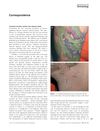 June 2011 in “International Journal of Dermatology”
 A man's red tattoo caused a skin reaction and hair loss in his beard, which improved after treatment.
 March 2026 in “Portuguese Journal of Dermatology and Venereology”
 This study observed an unexpected case where a 44-year-old woman developed linear scalp pigmentation, resembling a tattoo, after undergoing a microneedling procedure followed by hair dyeing two days later, emphasizing the need to advise patients on avoiding hair dye application soon after such treatments.
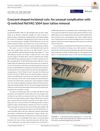 1 citations
,
November 2020 in “Journal of Cosmetic Dermatology”
1 citations
,
November 2020 in “Journal of Cosmetic Dermatology” This letter to the editor discusses an unusual complication, crescent-shaped incisional cuts, observed with Q-switched Nd:YAG 1064 laser tattoo removal and reports no new clinical results.
4 citations
,
January 2016 in “The Turkish Journal of Pediatrics” This case report details a 5-year-old girl who developed allergic contact dermatitis and temporary excessive hair growth on her arm after a henna tattoo application.
 November 2025 in “Dermatology Reports”
 This review found that microinfusion of medications using tattoo devices (MMP®) shows potential as a minimally invasive method for treating ailments like alopecia and basal cell carcinoma, offering notable improvements with minimal side effects due to localized drug delivery.
2 citations
,
May 2018 in “Dermatologic Surgery” This overview outlines the Dermatologic Surgery journal's comprehensive focus on cosmetic and reconstructive procedures, but it does not present any new research findings.
1 citations
,
April 2018 in “Dermatologic Surgery” This source outlines the scope and content of the Dermatologic Surgery journal, highlighting its focus on comprehensive peer-reviewed information related to various dermatologic surgeries, including cosmetic and reconstructive procedures and skin cancer treatment, as an essential resource for professionals in the field.
 January 2026 in “International Society of Hair Restoration Surgery”
 This study reports that a novel multimodal approach, combining tattoo machine–assisted drug delivery of hair loss treatments with oral and topical medications, may enhance hair density and thickness in androgenetic alopecia patients, though larger controlled studies are needed to confirm these early findings.
March 2026 in “Acta Dermato Venereologica” This study found that dermatology patients with tattoos or piercings may have a higher risk of body dysmorphic disorder tendencies and lower acceptance of their illness.
January 2019 in “Dermatologic Surgery” This overview of the Dermatologic Surgery journal describes its extensive coverage of peer-reviewed content across various skin surgery techniques but presents no new research findings.
May 2024 in “Anais Brasileiros de Dermatologia” This abstract discusses how a nevus may cause an interruption in tattoo pigment, with no new research findings reported.
 February 2026 in “Cureus”
 In this case report, a 38-year-old woman experienced progressive lightening of a blue-green eyebrow tattoo treated with a QS ruby laser, but eyebrow hair density reduction was noted as a potential adverse effect.
 37 citations
,
January 1989 in “British Journal of Plastic Surgery”
37 citations
,
January 1989 in “British Journal of Plastic Surgery” This study found that using a subcuticular non-absorbable suture for six months significantly reduced scar stretching and width compared to shorter-term suturing methods after tattoo removal.
 17 citations
,
January 1996 in “Aesthetic Plastic Surgery”
17 citations
,
January 1996 in “Aesthetic Plastic Surgery” This study suggests that the tumescent technique effectively provides anesthesia and reduces bleeding during hair micrografting, eliminating the need for multiple needle injections or nerve blocks.
 June 2024 in “International Journal of Dermatology”
 This study found that unsatisfactory scalp micropigmentation outcomes can be effectively corrected with interventions such as tattoo removal, repeated SMP, or hair transplant surgery, leading to high patient and physician satisfaction.