1 citations
,
July 2022 in “Indian Journal of Dermatology” This report describes the first documented case of bullous pyoderma gangrenosum developing on a cesarean section scar, which improved rapidly with oral prednisolone.
 June 2026 in “International Journal of Advanced Biochemistry Research”
 This report from a veterinary clinical case observed a two-year-old Lhasa apso with generalized demodicosis and severe secondary bacterial pyoderma, successfully treated through an integrated approach combining ivermectin, antimicrobials, and supportive therapies, resulting in significant clinical improvement.
 January 2018 in “Advances in Dermatology and Allergology”
 Treatment with dapsone, topical corticosteroids, and antibiotics improved the man's skin conditions.
2 citations
,
January 1990 in “PubMed” This case study highlights a 20-year-old male with perforating folliculitis, proposing its classification within primary perforating dermatoses, and discusses failed keratolytic treatments and potential underlying causes.
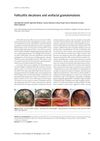
November 2014 in “The Pediatric Infectious Disease Journal” This case study of a 3-and-a-half-year-old girl with skin lesions revealed a diagnosis of extensive suppurative folliculitis with mixed granulomatous reaction upon further examination of hair follicles.
March 2026 in “Journal of Burn Care & Research” This case series examined five male burn patients who developed folliculitis barbae or pseudofolliculitis barbae, highlighting the underreported nature of these complications and the variability in treatment response. The authors call for standardized diagnostic criteria and treatment protocols for these conditions in burn survivors.
 January 2020 in “Annals of the Academy of Romanian Scientists Series of Medicine”
 This article discusses the proposed role of immunologic responses to staphylococcal superantigens in folliculitis decalvans and reports no clinical results; treatment should be tailored to the disease's severity.
July 2025 in “Journal of Investigative Dermatology” Upadacitinib effectively treats pyoderma gangrenosum.
29 citations
,
January 2005 in “Journal of Long-Term Effects of Medical Implants” This article reviews the clinical characteristics and treatment options for various common bacterial skin infections but presents no new clinical results.
 March 2023 in “Journal of the American Academy of Dermatology”
 This review summarizes evidence that pityrosporum folliculitis in immunocompromised patients responds well to topical antifungals and treatment of underlying conditions, based on a limited number of studies with small sample sizes.
 143 citations
,
September 1991 in “Archives of Dermatology”
143 citations
,
September 1991 in “Archives of Dermatology” In this study, patients with generalized pustular psoriasis were classified into subgroups to better understand the disease's variability and assist in treatment selection, highlighting the role of localized infections in triggering flares.
 1 citations
,
January 2013 in “The Journal of Dermatology”
1 citations
,
January 2013 in “The Journal of Dermatology” A skin condition called pyodermatitis vegetans was found in a patient with multiple myeloma for the first time.
1 citations
,
May 2024 in “Dermatology Online Journal” In this case study, two middle-aged patients with pruritic scalp erosions were diagnosed with localized pemphigus vulgaris, which resolved without relapse after treatment with low-dose oral prednisone and intralesional triamcinolone acetonide.
 9 citations
,
August 2002 in “Current Opinion in Pediatrics”
9 citations
,
August 2002 in “Current Opinion in Pediatrics” This article discusses the roles of pediatrics and dermatology departments at Yale University School of Medicine, but reports no specific clinical results.
 10 citations
,
May 1978 in “Acta Dermato Venereologica”
10 citations
,
May 1978 in “Acta Dermato Venereologica” In this study, seven patients with generalized toxic erythema developed sterile pustules localized to hair follicles or sweat ducts, with most having a history of medication, solvent exposure, or infection.
 12 citations
,
January 2005 in “Pediatric Dermatology”
12 citations
,
January 2005 in “Pediatric Dermatology” Fox Fordyce disease might be more common in prepubertal girls than thought and can be managed with treatment.
 August 2018 in “Journal of The American Academy of Dermatology”
 A 5-year-old girl with a rare skin disorder was effectively treated with skin creams instead of oral medication.
2 citations
,
January 2012 in “ACTA SCIENTIAE VETERINARIAE” This case report describes the successful topical treatment of a horse with a Pythium insidiosum infection using amphotericin B and DMSO, leading to significant wound healing and hair regrowth.
 January 2026 in “JOURNAL OF CLINICAL AND DIAGNOSTIC RESEARCH”
 In this case study, a 62-year-old male with a history of uncontrolled diabetes and chronic kidney disease was diagnosed with perforating folliculitis after presenting with dark, raised, pruritic lesions on his limbs, confirmed by histopathological examination showing collagen extruding into hair follicles.
11 citations
,
January 2009 in “Indian journal of dermatology, venereology, and leprology” This review discusses the characteristics, geography, and treatment challenges of dermatitis cruris pustulosa et atrophicans in men, emphasizing the need for further research on its etiology and management; it presents no new clinical findings.
9 citations
,
January 2015 in “Indian Dermatology Online Journal” This case report highlights the successful treatment of Kaposi varicelliform eruption in a pemphigus vulgaris patient using intravenous acyclovir, alongside antibiotics, resulting in healing of skin lesions with scarring.
 March 2019 in “Nasza Dermatologia Online”
 This case report describes a 52-year-old woman with a rare combination of pemphigus vulgaris and pemphigus foliaceus on the scalp, initially misdiagnosed as psoriasis, who achieved clinical remission and hair regrowth with corticosteroid treatment.
28 citations
,
May 1998 in “Journal of the American Academy of Dermatology” This case report suggests that tufted hair formation can occur in localized exudative inflammatory scalp lesions, as observed in a Japanese man with pemphigus vulgaris.
This article reviews a clinical case of pseudofolliculitis, highlighting its chronic nature, commonality in individuals with curly hair, and suggests management strategies, but reports no new clinical results.
 May 1993 in “Current problems in dermatology”
 This review discusses diagnostic approaches for childhood skin diseases with fever through clinical observations and covers recent advances in understanding the pathogenesis and epidemiology of related infections, without reporting new clinical results.
February 2023 in “Journal of the European Academy of Dermatology and Venereology” January 2023 in “Zenodo (CERN European Organization for Nuclear Research)” In this case report, an 8-month-old pug with poor health and skin issues was treated effectively for mixed infections, resulting in complete recovery after 60 days.
 April 2016 in “Journal of The American Academy of Dermatology”
 Finasteride effectively treated hidradenitis suppurativa.
6 citations
,
January 2014 in “Pediatric annals” This case report describes a 21-day-old infant with erythematous annular scaly plaques and pustules on the face and scalp, which did not improve with topical corticosteroid cream.
July 2011 in “Journal of Pediatric and Adolescent Gynecology” This report discusses a teenager with blistering of localized epidermolysis bullosa simplex—Weber Cockayne type, recommending referral to dermatology, and includes no new clinical trials or broader conclusions.