 June 2023 in “International Journal of Research in Dermatology”
 In this study, obese patients who underwent bariatric surgery experienced significant weight loss, which was associated with improvements in certain skin conditions, such as intertrigo, tinea corporis, and striae rubra, although the prevalence of many other skin diseases remained unchanged.
 May 2023 in “Journal of Cosmetic Dermatology”
 This study found that obese and overweight children have higher prevalence of certain skin disorders like keratosis pilaris and acanthosis nigricans, with these conditions being linked to insulin resistance and more likely in children with darker skin tones.
 February 2023 in “Pakistan Journal of Medical and Health Sciences”
 This study found a variety of dermatological conditions in pregnant women, with Striae Gravidarum being the most prevalent at 48.1%, followed by Linea Nigra at 45.9%.
 July 2022 in “International Journal of Health Sciences (IJHS)”
 This study found that skin changes such as pigmentary alterations, vascular and connective tissue changes are common during pregnancy, with areola/nipple darkening and striae gravidarum frequently observed.
 February 2022 in “Cleveland Clinic Journal of Medicine”
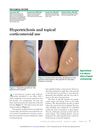
 This case report observed hypertrichosis on the left forearm of an 80-year-old woman, possibly linked to her previous use of the topical steroid betamethasone butyrate propionate for dermatitis.
 December 2021 in “Journal of clinical images and medical case reports”
 This descriptive study observed that a "moth-eaten" pattern of hair loss can occur in several skin diseases, with lichen planopilaris and discoid lupus erythematosus being among the most common conditions identified in patients from Baghdad, emphasizing its potential as a diagnostic tool for clinicians.
 September 2021 in “CRC Press eBooks”
 This article reviews various skin changes and conditions during pregnancy, noting that while many are normal, some can become pathologic, but it reports no new research findings.
 November 2019 in “Harper's Textbook of Pediatric Dermatology”
 This review discusses the skin manifestations associated with metabolic syndrome and related conditions in young populations, noting associations with obesity, insulin resistance, and neonatal obesity, but reports no new clinical results.
 October 2017 in “Journal of medical science and clinical research”
 This study found that obese individuals commonly experienced skin manifestations such as acanthosis nigricans, hyperandrogenism features, and increased cutaneous infections compared to non-obese individuals.
 August 2009 in “Expert Review of Dermatology”
 This review examines physiological changes and dermatoses during pregnancy and reports no clinical results, highlighting the importance of recognizing these conditions for appropriate management.
This article discusses the potency grading of steroid skin creams and highlights that very potent or potent steroids (grades I and II) can cause significant side effects, especially in children.
227 citations
,
February 1989 in “The Journal of Comparative Neurology” This study found that calcitonin‐gene‐related peptide immunoreactive sensory axons in rats are predominantly involved in tissue maintenance rather than nociceptive functions.
 62 citations
,
April 2008 in “Neurobiology of aging”
62 citations
,
April 2008 in “Neurobiology of aging” This study identified a new genetic locus, ahl4, on distal Chromosome 10 that contributes to the early-onset, severe hearing loss in A/J mice compared to B6 mice.
13 citations
,
August 2021 in “Frontiers in Aging Neuroscience” This study found that in SAMP8 mice, phenotypic changes in outer hair cells or the stria vascularis, possibly due to oxidative deficiencies, may predict variability in age-related hearing loss before outer hair cell loss occurs.
 5 citations
,
November 2021 in “Frontiers in Cell and Developmental Biology”
5 citations
,
November 2021 in “Frontiers in Cell and Developmental Biology” Caffeine can damage hearing cells and affect hearing recovery after ear trauma.
4 citations
,
October 2023 in “Children” This study diagnosed a group of six girls with various ectodermal abnormalities, identifying cranio-skeletal malformations consistent with focal dermal hypoplasia (Goltz syndrome), and found heterozygous mutations in the PORCN gene in two children.
 4 citations
,
May 2019 in “Physiology & Behavior”
4 citations
,
May 2019 in “Physiology & Behavior” This study found that cocaine disrupted the relationship between certain brain androgen levels and sexual behavior in male rats, with dose-dependent effects on testosterone metabolism.
2 citations
,
September 2004 in “Experimental Dermatology” This review discusses how dysfunction in keratinocyte adhesion affects skin integrity and conditions like alopecia and keratoderma, highlighting the roles of intercellular junctions, and reports no new clinical results.
 September 2024 in “Skin Research and Technology”
 This study used atomic force microscopy to identify significant morphological differences in hair from patients with lichen planopilaris compared to healthy controls, noting more scratches, uneven edges, and pitted scales in affected hair, which may aid future research on the condition.
 243 citations
,
September 2016 in “Dermatology and Therapy”
243 citations
,
September 2016 in “Dermatology and Therapy” This article provides an overview of how dermoscopy can aid in the noninvasive diagnosis of various general dermatological disorders, grouped by clinical presentation, but reports no new clinical results.
25 citations
,
January 1978 in “JAMA” This case report describes a 45-year-old woman who developed Cushing's syndrome and hirsutism after using topically applied desoximetasone (Topicorte).
 3 citations
,
January 2018 in “Indian Dermatology Online Journal”
3 citations
,
January 2018 in “Indian Dermatology Online Journal” This study found that normal physiological cutaneous changes were the most common skin changes during pregnancy in Northeast India, while specific dermatoses were rare and not significantly influenced by ethnicity or geography.
 6 citations
,
September 1994 in “Veterinary Clinics of North America: Small Animal Practice”
6 citations
,
September 1994 in “Veterinary Clinics of North America: Small Animal Practice” This review examines skin diseases affecting the pinna of dogs and cats, highlighting those unique to this area and noting its role as a common initial site for several conditions; it reports no new results.
 4 citations
,
July 2019 in “Clinics in Dermatology”
4 citations
,
July 2019 in “Clinics in Dermatology” This article reviews various "white diseases" characterized by hypopigmentation or depigmentation and emphasizes the role of melanosomes in skin and eye color, but it does not present new clinical results.
2 citations
,
November 2023 in “Skin Research and Technology” This study found that RCM combined with dermoscopy can differentiate disease states between alopecia areata, tinea capitis, nevus sebaceous, and linear scleroderma of the scalp by identifying distinct dermal and follicular patterns.
 2 citations
,
April 2018 in “International Journal of Research in Dermatology”
2 citations
,
April 2018 in “International Journal of Research in Dermatology” In this study, lichen striatus was the most common linear dermatosis observed, with most lesions occurring along Blaschko’s lines, and histopathological evaluation often revealed different underlying conditions.
This study observed that low doses of a mixture of Chinese herb extracts promoted hair growth in vitro, while high doses inhibited it.
This study found that extract mixtures from certain Chinese herbs promoted hair growth in mice by inducing and prolonging the anagen phase when applied both intragastrically and topically.
30 citations
,
May 1980 in “Journal of the American Academy of Dermatology” In this study, three patients with alopecia areata exhibited spotty absence of the whiteness of their nail lunulae, potentially due to defects in the matrical epithelium.
 January 2021 in “Systematic Reviews in Pharmacy”
 This study found that 90% of pregnant women experience physiological skin changes, with Striae Gravidarum being the most common, especially in multigravid individuals.