 October 2023 in “The Journal of clinical endocrinology and metabolism/Journal of clinical endocrinology & metabolism”
 This review found that hyperandrogenism in premenopausal women is linked to a higher prevalence of cardiovascular risk factors and diseases regardless of obesity, while in postmenopausal women, these risks depend on obesity.
 April 2022 in “International Journal of Nursing Education”
 This study assessed the knowledge of post-menopausal women about the effects of pranayama on post-menopausal symptoms and found that participants had an average level of understanding.
 December 2021 in “Aegean journal of obstetrics and gynecology”
 This case report highlights a rare instance of postmenopausal virilization in a 71-year-old woman due to coexisting ovarian hilus cell hyperplasia and a Sertoli-Leydig cell tumor.
June 2020 in “ACTA MEDICA IRANICA” This case report describes a postmenopausal woman with virilization and an ovarian steroid cell tumor, highlighting the rarity and diagnostic importance of such tumors in this demographic.
 December 2013 in “Macedonian Journal of Medical Sciences”
 This case report describes a 69-year-old woman with hirsutism and elevated serum testosterone, where surgery resolved symptoms and serum testosterone, suggesting ovarian steroid cell tumor consideration in similar profiles.
 May 2013 in “Journal of the ASEAN Federation of Endocrine Societies”
 This case study reports that a 61-year-old woman with high testosterone levels due to stromal luteoma of the left ovary experienced rapid normalization of testosterone levels after surgical removal of the tumor.
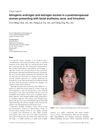 August 2009 in “International Journal of Dermatology”
 This case report describes a postmenopausal woman who experienced facial erythema, acne, and hirsutism due to excess androgen and estrogen levels.
 145 citations
,
December 1999 in “Journal of Investigative Dermatology Symposium Proceedings”
145 citations
,
December 1999 in “Journal of Investigative Dermatology Symposium Proceedings” Finasteride 1mg helps reverse hair miniaturization in men and postmenopausal women.
22 citations
,
January 2019 in “Climacteric” This study reports that oophorectomy significantly reduces serum testosterone levels in postmenopausal women, indicating the postmenopausal ovary's continued production of testosterone.
 18 citations
,
May 2014 in “Menopause”
18 citations
,
May 2014 in “Menopause” This study found that a 5-mg daily dose of transdermal testosterone cream in postmenopausal women restored testosterone levels to those typical of premenopausal women.
 17 citations
,
May 2012 in “Clinical Endocrinology”
17 citations
,
May 2012 in “Clinical Endocrinology” This study found that surgical normalization of testosterone in hyperandrogenic women with ovarian androgen-secreting tumors did not significantly change body weight or insulin sensitivity after 12 months.
 14 citations
,
January 2008 in “Gynecological Endocrinology”
14 citations
,
January 2008 in “Gynecological Endocrinology” This study reports that in women with non-tumor hyperandrogenism, a decrease in serum testosterone from insulin-sensitizing therapy like metformin may indicate a low likelihood of having an androgen-secreting tumor.
 12 citations
,
March 2018 in “Medicine”
12 citations
,
March 2018 in “Medicine” This case report describes a 60-year-old woman with an ovarian Leydig cell tumor leading to elevated testosterone levels and hirsutism, highlighting the need to consider androgen-secreting tumors in similar postmenopausal cases.
 9 citations
,
January 2007 in “Endocrine Practice”
9 citations
,
January 2007 in “Endocrine Practice” This case report describes a 60-year-old postmenopausal woman with virilization and hirsutism caused by hilus-cell hyperplasia, which was confirmed following bilateral salpingo-oophorectomy.
 6 citations
,
November 2007 in “British Journal of Dermatology”
6 citations
,
November 2007 in “British Journal of Dermatology” This study found that topical fulvestrant did not significantly improve hair growth parameters in men and postmenopausal women with androgenetic alopecia, unlike minoxidil, which was more effective in men.
6 citations
,
June 2006 in “International Journal of Gynecological Pathology” This study reports that in a case of benign Brenner tumor, elevated androgens may originate from luteinized stromal cells, as these cells do not convert androgen to estrogen due to suppressed aromatase biosynthesis.
5 citations
,
September 2023 in “Nutrients” In this study, a 6-month randomized controlled trial with postmenopausal women reported that supplementing with soy protein isolate with isoflavones led to significant improvements in skin hydration and reduced wrinkles and facial pigment intensity, but did not affect sebum production.
 3 citations
,
October 2022 in “International Journal of Impotence Research”
3 citations
,
October 2022 in “International Journal of Impotence Research” This article reviews the role of testosterone in sexual health, supporting Testosterone Replacement Therapy as an effective treatment for Hypoactive Sexual Desire Disorder in postmenopausal women, though more research is needed on its long-term effects and applicability to premenopausal women.
 2 citations
,
April 2023 in “Pharmaceuticals”
2 citations
,
April 2023 in “Pharmaceuticals” This review discusses the controversial cardiovascular safety and efficacy of subcutaneous testosterone therapy in postmenopausal women, noting that its long-term use appears safe, but CV risk assessments remain disputed.
 2 citations
,
May 2018 in “Diagnosis”
2 citations
,
May 2018 in “Diagnosis” This case report presents a rare instance of an ovarian steroid cell tumor in a 68-year-old female with virilism, which normalized androgen levels following surgical removal.
 1 citations
,
July 2021 in “Research Square (Research Square)”
1 citations
,
July 2021 in “Research Square (Research Square)” This study found that osteoporosis is common among Sudanese postmenopausal women, who also showed an increased risk for cardiovascular disease, emphasizing the need for enhanced public health education and preventive measures.
October 2025 in “Journal of the Endocrine Society” In this case report, the coexistence of hypercalcemia and androgen excess in a postmenopausal woman was linked to primary hyperparathyroidism and a suspected androgen-secreting ovarian tumor, underscoring the need for a comprehensive diagnostic approach to identify overlapping endocrine disorders.
May 2025 in “Journal of the ASEAN Federation of Endocrine Societies” This case report highlights the need to assess postmenopausal women with hirsutism for hyperandrogenism causes, as exemplified by a Leydig cell tumor coinciding with primary hyperparathyroidism.
 October 2024 in “Journal of the Endocrine Society”
 In this case report, a 62-year-old woman with hyperandrogenism and polycythemia was diagnosed with a rare ovarian steroid cell tumor, highlighting the importance of considering such tumors in similar presentations; surgical removal led to symptom and lab normalization.
 October 2024 in “Journal of the Endocrine Society”
 This case report details a diagnostic challenge in a postmenopausal woman with severe hyperandrogenism where distinguishing between adrenal and ovarian causes was complicated by elevated 17-OH Progesterone and asymmetric ovarian enlargement; pending surgical pathology is expected to guide further management.
 October 2024 in “Journal of the Endocrine Society”
 In this case study, a postmenopausal woman with symptoms of virilization was diagnosed with a rare ovarian Leydig cell tumor, and surgical removal led to a resolution of her hyperandrogenism and related symptoms, highlighting the importance of thorough differential diagnosis in postmenopausal hyperandrogenism.
May 2024 in “International journal of medicine and psychology.” In this study, combining transcranial electrical stimulation with bisphosphonate therapy in patients with postmenopausal osteoporosis resulted in a protective effect on bone collagen synthesis, as indicated by higher P1NP levels over 12 months, compared to bisphosphonates alone.
 May 2021 in “Journal of the Endocrine Society”
 This case report describes the rare association of an ovarian Leydig cell tumor and primary hyperparathyroidism in a postmenopausal woman, highlighting the importance of considering rare causes in patients with virilizing symptoms.
April 2019 in “Journal of the Endocrine Society” In this case study, the researchers reported that treating a woman with type B insulin resistance using rituximab, dexamethasone, and cyclophosphamide greatly reduced her insulin needs, but her hyperandrogenic state persisted, suggesting ovarian hyperthecosis.
April 2019 in “Journal of the Endocrine Society” This case report described a 62-year-old postmenopausal woman with hirsutism whose symptoms improved after a hysterectomy and bilateral oophorectomy, revealing bilateral ovarian hyperthecosis.