29 citations
,
July 2008 in “British Journal of Dermatology” This case report examines a patient with myasthenia gravis, invasive thymoma, and paraneoplastic pemphigus associated with alopecia areata, notably without the usual mucosal involvement.
105 citations
,
December 2003 in “Veterinary Dermatology” This review discusses the association between cutaneous paraneoplastic syndromes and internal malignancies, noting that recognition of these skin disorders may help detect underlying cancers, but reports no new research findings.
April 2018 in “Blackwell's Five‐Minute Veterinary Consult Clinical Companion” This chapter reviews the characteristics, diagnosis, and management of preneoplastic and paraneoplastic syndromes in small animals but does not present new clinical findings.
October 2017 in “Journal of Investigative Dermatology” This article presents a diagnostic quiz based on clinical images and reports findings from the mentioned article but does not provide new clinical results.
April 2011 in “Companion Animal” This article reviews the clinical presentation, diagnosis, and management of feline pododermatitis, discussing conditions like trombiculidiasis and bacterial paronychia, but reports no new clinical results.
 August 2025 in “Frontiers in Immunology”
 This case report is the first to document the coexistence of bullous pemphigoid, malignant tumors, and alopecia areata in a patient, highlighting the complete resolution of skin lesions with dupilumab and spontaneous hair regrowth without disease-specific treatment.
 34 citations
,
March 2015 in “Clinical and Experimental Dermatology”
34 citations
,
March 2015 in “Clinical and Experimental Dermatology” This study observed that patients with pemphigus have a higher incidence of hypothyroidism, inflammatory bowel disease, and diabetes compared to the general population.
 31 citations
,
June 2011 in “Journal of the neurological sciences”
31 citations
,
June 2011 in “Journal of the neurological sciences” In this case report, a patient with thymoma was observed to have four co-occurring paraneoplastic autoimmune disorders that improved after thymectomy, suggesting a possible link between thymoma and these conditions.
 23 citations
,
November 2014 in “Anais Brasileiros de Dermatologia”
23 citations
,
November 2014 in “Anais Brasileiros de Dermatologia” This study suggests that trichoscopy may assist in diagnosing pemphigus, particularly for scalp-specific lesions, by identifying certain characteristic features.
 13 citations
,
January 2018 in “BioMed Research International”
13 citations
,
January 2018 in “BioMed Research International” This review summarizes recent findings on scalp involvement in pemphigus vulgaris and pemphigus foliaceus, highlighting diagnostic methods and their underlying histopathological, immunopathological, and clinical features, but reports no new clinical results.
 9 citations
,
August 2002 in “Current Opinion in Pediatrics”
9 citations
,
August 2002 in “Current Opinion in Pediatrics” This article discusses the roles of pediatrics and dermatology departments at Yale University School of Medicine, but reports no specific clinical results.
 2 citations
,
March 2019 in “Veterinary dermatology”
2 citations
,
March 2019 in “Veterinary dermatology” The authors concluded that thymoma-associated paraneoplastic syndrome in cats may manifest as noninflammatory alopecia instead of exfoliative dermatitis, and should be considered when diagnosing multifocal noninflammatory alopecia.
 March 2026 in “Indian journal of veterinary and animal sciences research.”
 In this study, a five-year-old Labrador with pemphigus, characterized by erythematous lesions and confirmed through cytology, was successfully treated with a six-week regimen of oral immunosuppressive azathioprine and supportive medications, resulting in total recovery.
 44 citations
,
May 2006 in “The Journal of the American Animal Hospital Association/Journal of the American Animal Hospital Association”
44 citations
,
May 2006 in “The Journal of the American Animal Hospital Association/Journal of the American Animal Hospital Association” This study observed that combination therapy with prednisolone and azathioprine provided similar outcomes to prednisolone alone for treating pemphigus foliaceus in dogs, with over half achieving remission and significant improvement in another 25%.
1 citations
,
September 2019 in “Journal of Investigative Dermatology” This study developed a pemphigus model in mice showing that anti-Desmocollin 3 and anti-Desmoglein 3 antibodies lead to more severe disease, suggesting diverse antigens contribute to varying human pemphigus phenotypes.
1 citations
,
August 2019 In this study, researchers developed a pemphigus mouse model expressing anti-Desmocollin 3 antibodies and found it mimicked atypical pemphigus with distinct pathological features compared to the standard Desmoglein 3 model.
 40 citations
,
July 2007 in “Dermatologic Therapy”
40 citations
,
July 2007 in “Dermatologic Therapy” This review discusses the pharmacologic properties, mechanisms, dosing options, and adverse effects of systemic glucocorticosteroids in dermatology, but reports no new findings.
 24 citations
,
June 2018 in “Reviews in endocrine and metabolic disorders”
24 citations
,
June 2018 in “Reviews in endocrine and metabolic disorders” This review discusses the epidemiology, clinical manifestations, and pathogenesis of autoimmune skin diseases and their associations with thyroid diseases, reporting no new clinical results.
 13 citations
,
August 2017 in “International Journal of Dermatology”
13 citations
,
August 2017 in “International Journal of Dermatology” This study reported that trichoscopy revealed distinctive patterns across different autoimmune bullous diseases, suggesting it can be a useful preliminary diagnostic tool for differentiating these conditions.
 7 citations
,
July 2019 in “Clinics in Dermatology”
7 citations
,
July 2019 in “Clinics in Dermatology” This review discusses various systemic diseases associated with secondary alopecia and reports no new clinical findings; it emphasizes the importance of addressing underlying conditions and using diagnostic tools like trichoscopy and histopathology.
 3 citations
,
October 2021 in “Brain Sciences”
3 citations
,
October 2021 in “Brain Sciences” This review hypothesizes that risperidone long-acting injectable may be linked to bullous pemphigoid in a bipolar patient, though current studies report mixed results.
1 citations
,
January 2018 in “Cogent Medicine” This case study reports a pregnant woman with bullous pemphigoid who developed Cushing syndrome following steroid treatment, emphasizing the need for careful management of steroid-related complications.
 9 citations
,
July 2002 in “Journal of the European Academy of Dermatology and Venereology”
9 citations
,
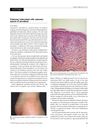
July 2002 in “Journal of the European Academy of Dermatology and Venereology” This article discusses multiple minute digitate hyperkeratosis in a dermatological context and reports no new clinical findings; the authors focus on a descriptive review.
28 citations
,
May 1998 in “Journal of the American Academy of Dermatology” This case report suggests that tufted hair formation can occur in localized exudative inflammatory scalp lesions, as observed in a Japanese man with pemphigus vulgaris.
 1 citations
,
April 2022 in “JAAD case reports”
1 citations
,
April 2022 in “JAAD case reports” This case report describes a unique instance of IgG/IgA pemphigus in a Chinese woman, highlighting its distinct clinical and immunopathologic characteristics, including successful management with dapsone and prednisolone.
 October 2007 in “Journal of Investigative Dermatology”
 The meeting highlighted the genetic basis of female pattern hair loss and various skin health insights.
This case report describes an 11-year-old canine diagnosed with Pemphigus Foliaceus, illustrating the role of trichogram, skin scraping, cytology, and histopathology in achieving an accurate diagnosis.
 2 citations
,
January 2005 in “Elsevier eBooks”
2 citations
,
January 2005 in “Elsevier eBooks” The document describes skin diseases affecting the outer ear in dogs and cats, their spread to other body parts, and treatment options.
 February 2024 in “Curēus”
 This review highlights the critical importance of a balanced diet, with adequate proteins, vitamins, and minerals, to support skin health and potentially treat inflammatory skin conditions like psoriasis and atopic dermatitis, emphasizing the need for evidence-based dietary guidance.
 August 2023 in “Dermatology and Therapy”
 This review discusses the increasing reports of rare cutaneous side effects from topical imiquimod, aiming to inform physicians and dermatologists about its potential adverse effects as its use expands.