1 citations
,
June 2025 in “Journal of Cellular and Molecular Medicine” This study explored the role of plant-derived monomers in reversing grey hair, finding that compounds like fraxinol and morin may stimulate melanin production and tyrosinase activity, suggesting potential therapeutic benefits, although further evaluation of their safety and efficacy is needed.
 June 2025 in “BMJ Case Reports”
 In this case report, researchers observed hair repigmentation in a man with metastatic renal cell carcinoma during treatment with axitinib, marking the first documented instance of this effect with axitinib without the use of hair dyes or other medications.
 March 2026 in “International Journal of Homoeopathic Sciences”
 In this study, 10.25% of school children aged 5-15 in Belagavi were found to have premature greying of hair, with the majority showing mild severity according to the Graying Severity Score.
 24 citations
,
October 2024 in “Process Biochemistry”
24 citations
,
October 2024 in “Process Biochemistry” In this study, Gaussian process regression models combined with Grey Wolf optimization were used to predict and optimize phenolic and flavonoid content extraction from Carthamus caeruleus L. rhizomes, showing high accuracy and helping improve understanding and extraction processes through a new interactive tool.
45 citations
,
June 2012 in “JRSM Cardiovascular Disease” In this study, premature coronary artery disease in Indians under 40 was linked to factors like dyslipidemia, low HDL-C, smoking, and central obesity, with cutaneous markers significantly associated.
31 citations
,
December 2012 in “British Journal of Dermatology” This study found that as Korean women age, their hair density, diameter, tensile strength, and lustre decline, while grey hair ratio and certain sterol contents increase, suggesting unique ageing features compared to women in other countries.
 27 citations
,
December 2020 in “Experimental Dermatology”
27 citations
,
December 2020 in “Experimental Dermatology” This study reported that COVID-19 was causally associated with postinfectious hair shedding, which varied with disease severity, but hair completely recovered.
4 citations
,
August 2018 in “Journal of cellular biochemistry” This study found that sustained intracellular acidosis in mice was associated with shortened lifespan, early aging signs, and impaired autophagy.
 4 citations
,
March 2017 in “Journal of evolution of medical and dental sciences”
4 citations
,
March 2017 in “Journal of evolution of medical and dental sciences” This study observed that pruritus and xerosis were the most common skin complaints among the geriatric population attending a dermatology clinic in Puducherry.
 3 citations
,
February 2024 in “International Journal of Pharmaceutical Sciences Review and Research”
3 citations
,
February 2024 in “International Journal of Pharmaceutical Sciences Review and Research” This study suggests that a herbal oil formulation combining various plant and oil ingredients may effectively promote healthy hair growth and address concerns like baldness, dryness, and dandruff, supported by favorable evaluations of its physical and chemical properties.
1 citations
,
January 2012 in “Human health handbooks” This review discusses the factors influencing human hair color, including genetic components like the MC1R gene and enzyme activity, without presenting new experimental results.
January 2026 in “International Journal of Cosmetic Science” This study identifies key attributes—luminosity, structural integrity, and vitality—that define hair vibrancy, providing insights to guide the development of hair products that align with consumer expectations.
This review discusses various Complementary and Alternative Medicine methods for hair care, such as herbal remedies and hair regeneration techniques, but reports no new clinical findings.
This study prepared herbal hair oil using ingredients like coconut oil, amla, neem, hibiscus, and onion, and reported that the formulations exhibit anti-hairfall properties along with benefits like antidandruff activity, improved scalp circulation, and reduced hair whitening compared to synthetic alternatives.
 January 2025 in “International Journal of Advanced Research in Science Communication and Technology”
 In this study, a herbal hair oil formulated using ingredients like Amla, garlic, and curry leaves significantly increased hair number and length, reduced hair growth completion time, and showed comparable effects to minoxidil, demonstrating anti-dandruff and other hair-enhancing properties with fewer side effects.
 October 2024 in “Journal of the Pakistan Medical Association”
 This letter discusses the various risk factors associated with premature greying of hair, highlighting genetic predispositions, nutritional deficiencies, stress, and lifestyle factors, while noting a lack of conclusive data on effective interventions, as detailed in the reviewed studies.
 February 2023 in “Journal of Pre-Clinical and Clinical Research”
 Dhathri Hair Care Plus herbal oil helps reduce hair loss, treat scalp conditions, and slow down hair greying.
 January 2023 in “Fashion and textiles”
 This study found that hair dyed with anionic basic hair dye lost more color after shampooing compared to cationic and nonionic dyes, with alkaline shampoo increasing this effect.
 June 2021 in “CRC Press eBooks”
 This source summarizes current and potential phytocosmetics for hair care, noting their fewer side effects compared to synthetic agents, but emphasizes the need for research on their development to align with consumer preferences.
This study found that some white or grey hairs can naturally regain pigmentation, suggesting hair greying may be reversible in certain conditions linked to psychological stress.
April 2017 in “The FASEB journal” This study suggests that selenium deprivation in mice accelerates age-related degeneration but paradoxically promotes longevity, potentially decoupling healthspan from lifespan.
April 2015 in “The FASEB Journal” This study suggests that selenium deficiency accelerates aging-related health deterioration in mice with short telomeres, providing a model for exploring selenium’s role in human aging.

This article discusses ongoing research efforts to develop natural anti-androgenetic alopecia treatments using bioactive compounds from medicinal plants but reports no new clinical results.
This study found that some white or grey human hairs can naturally regain pigmentation, suggesting a potential temporary reversibility of hair greying associated with stress and molecular changes.
 June 2024 in “British Journal of Dermatology”
 In this case report, an 80-year-old woman experienced darkening of previously grey hair, which may be linked to vitamin B supplementation, though its effectiveness is typically associated with reversing greying only in the presence of an initial vitamin B deficiency.
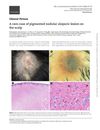
This study reported the case of a 30-year-old man with a bluish-grey scalp nodule that developed over a previously stable hairless plaque, revealing histopathological features consistent with epithelioid cell nests and spindle-shaped dermal melanocytes embedded in collagen.
June 2025 in “Clinical and Experimental Dermatology” This report describes a rare case where a 76-year-old man's grey scalp hair unexpectedly regained its original orange to brown color after he underwent radiotherapy for squamous cell carcinoma, suggesting possible implications involving hair follicle melanocytes and radiation effects.
 35 citations
,
January 2009 in “Indian Journal of Dermatology, Venereology and Leprology”
35 citations
,
January 2009 in “Indian Journal of Dermatology, Venereology and Leprology” Older adults commonly experience wrinkles, itchy skin, psoriasis, fungal infections, skin growths, grey hair, hair loss, and nail ridging, but no skin cancer was found in this group.
16 citations
,
August 2000 in “Il Farmaco” This study observed that tryptophan levels in human hair are higher in males than females, increase with age, and vary with hair color, being highest in grey and white hair.
 December 2025 in “International Journal of Research in Dermatology”
 This clinical study in healthy Indian adults found that a four-month application of an Ayurvedic leave-on treatment significantly increased natural black hair density, reduced grey hair count, and was well-tolerated without adverse effects, suggesting its efficacy and safety for treating premature hair greying.