3 citations
,
November 2015 in “International Journal of Dermatology” This study found that trichostasis spinulosa is a common condition primarily affecting the face across all ages, with a higher prevalence in women than men.
2 citations
,
December 2022 in “Archives of Dermatological Research” In this study, researchers developed a new classification system for anterior hairline types among Asian males without androgenetic alopecia, finding MM, RM, and ML to be the most common types.
 2 citations
,
January 2020 in “Elsevier eBooks”
2 citations
,
January 2020 in “Elsevier eBooks” The document concludes that individualized Facial Feminization Surgery plans and comprehensive care are crucial for successful outcomes.
 2 citations
,
January 2014 in “Archives of Aesthetic Plastic Surgery”
2 citations
,
January 2014 in “Archives of Aesthetic Plastic Surgery” The authors concluded that total hairline correction, which addresses multiple areas beyond the frontotemporal recess, is more effective in improving aesthetic facial balance for women with M-shaped or rectangular hairlines.
 1 citations
,
July 2023 in “Journal of the European Academy of Dermatology and Venereology”
1 citations
,
July 2023 in “Journal of the European Academy of Dermatology and Venereology” This study observed that female portraits from the past millennium show a trend of forward-moving hairlines over time, which may provide insights into the natural history of frontal fibrosing alopecia.
This source reports that modern hair transplant techniques, including follicular unit grafting, can create natural-looking results and are increasingly used beyond male pattern baldness to treat areas like eyebrows and scars, while even some controversial indications are being explored.
 1 citations
,
February 2018 in “Journal of Nepal Medical Association”
1 citations
,
February 2018 in “Journal of Nepal Medical Association” This study followed 152 patients undergoing hair transplant surgery, reporting that 86.18% experienced excellent results after one year, despite temporary complications like forehead swelling in 69.74% of participants, suggesting the procedure's relative safety and effectiveness for androgenetic alopecia.
 1 citations
,
January 2014 in “Annals of Dermatology”
1 citations
,
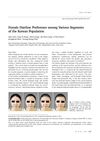
January 2014 in “Annals of Dermatology” This study surveyed hairline preferences and found that the M-shaped contour was most preferred overall, with lower forehead heights favored by men and those without a history of hair transplantation.
 1 citations
,
June 2012 in “Revista Brasileira de Cirurgia Plástica”
1 citations
,
June 2012 in “Revista Brasileira de Cirurgia Plástica” In this study, the authors reported that frontal rhytidectomy with a pre-hairline incision effectively reduces a long forehead in select patients, with patients feeling the benefits outweighed the visibility of the scar.
 1 citations
,
February 2007 in “Plastic and Reconstructive Surgery”
1 citations
,
February 2007 in “Plastic and Reconstructive Surgery” This review covers the extensive range of aesthetic and reconstructive surgery detailed in Volumes 2 and 3 of "Plastic Surgery," highlighting its comprehensive and well-organized content but reports no new clinical results.
 April 2023 in “Journal of dermatological treatment”
 This study reports a case of complete hair regrowth in lichen planopilaris after 12 weeks of treatment with ixekizumab, suggesting its potential as a targeted therapy.
April 2017 in “Huisarts en Wetenschap” Female pattern hair loss causes significant hair thinning and affects self-confidence.
This review highlights that hair care products can cause adverse effects like irritation dermatitis and allergic contact eczema but does not report new clinical findings.
January 2025 in “Surgical & Cosmetic Dermatology” This report discusses a 48-year-old patient with androgenetic alopecia and basal cell carcinoma on the right hairline, where forehead reduction surgery and tumor excision were performed simultaneously, improving aesthetics and resolving the cancer issue.
 November 2022 in “Journal of Investigative Dermatology”
 This study suggests that applying a botanical extract targeting mechanosensory receptors improved well-being, oxytocin levels, and skin appearance in participants, unlike a placebo.
 July 2018 in “British Journal of Dermatology”
 Hair regrowth was seen in 83% of children with alopecia, immune system plays a role in the condition, and various treatments showed effectiveness for hair and nail disorders.
 October 2017 in “Dermatologic Surgery”
 Men are increasingly getting botulinum toxin treatments, requiring higher doses and different techniques than women for a natural look.
 January 2017 in “Elsevier eBooks”
 The document concludes that choosing the right forehead and brow lifting technique based on individual patient characteristics is crucial to prevent complications and achieve desired results.

This chapter discusses the role of orthognathic surgeons in facial feminization surgery, focusing on procedures such as forehead reduction and orbital rim contouring, but reports no new clinical results.
This review discusses various brow lift techniques and considerations, highlighting that endoscopic brow lifts may raise the hairline and should be cautiously used with certain patients due to potential complications.
 November 2013 in “Facial Plastic Surgery Clinics of North America”
 The document concludes that careful techniques, proper patient selection, and management strategies are crucial to minimize complications in facial plastic surgery.
 May 1999 in “Journal of Oral and Maxillofacial Surgery”
 The book provides practical guidance on cosmetic facial surgery for clinicians.
January 2013 in “Journal of Hubei University of Science and Technology(Medical Sciences)” This study found that androgenetic alopecia patients with a family history tend to experience earlier onset, less forehead hair loss in males, and more severe patterns compared to those without a family history.
25 citations
,
October 2000 in “Gene” This study found that Foxn1-like genes in fish and mice are functionally equivalent in activating hair keratin genes, whereas changes in the cephalochordate Foxn1-like gene result in inactivity.
20 citations
,
December 2020 in “Frontiers in Immunology” This study found that certain T cell-associated genes were upregulated in dogs with Vogt-Koyanagi-Harada syndrome and vitiligo, suggesting a shared immunopathogenesis with humans.
3 citations
,
March 2017 in “Pediatric Dermatology” This case report documents the first known instance of FOXN1 duplication linked to congenital hypertrichosis.
1 citations
,
October 2021 in “The journal of investigative dermatology/Journal of investigative dermatology” This study found that depleting HIF-P4H-2 in FoxD1-lineage cells in mice led to disrupted hair follicle development, resulting in truncal alopecia but normal cranial hair, suggesting its crucial role in hair homeostasis.
 September 2025 in “Digital Commons - RU (Rockefeller University)”
 In this study, researchers found that mice lacking the transcription factor FOXC1 in their hair follicle stem cells had increased rounds of hair regeneration but experienced hair thinning due to impaired ability to maintain stem cell quiescence and adhesion.

This study in diabetic db/db mice found that treatment with the antihypertensive agents minoxidil or nebivolol stimulated elastogenesis and inhibited elastolysis, leading to restored elastic fibers, reduced aortic stiffening, and normalized blood pressure.
May 2018 in “The journal of immunology/The Journal of immunology” This study identified that patients with compound heterozygous mutations in FOXN1 exhibited severe T-cell lymphopenia but retained normal hair and nail development, indicating a distinct clinical phenotype from classic FOXN1 cases.