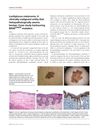
December 2017 in “Canadian journal of ophthalmology” This paper reports a rare case of focal mucinosis in a 58-year-old woman's eyelid, initially resembling a nevus, successfully treated with surgical excision with no recurrence over a three-year follow-up.
 1 citations
,
March 2015 in “Journal of the European Academy of Dermatology and Venereology”
1 citations
,
March 2015 in “Journal of the European Academy of Dermatology and Venereology” This letter to the editor shares a case study of lentiginous melanoma that appears clinically malignant but histopathologically benign, involving the BRAFV600R mutation.
 February 2024 in “Journal of the American Academy of Dermatology”
 Vascular patterns in dermoscopy help tell apart malignant and benign skin tumors.
11 citations
,
April 2012 in “American Journal of Dermatopathology” This study confirms previous observations that benign lipogenic lesions may contain eccrine/apocrine glandular components, potentially due to adipocytic proliferation entrapping glandular structures.
 1 citations
,
March 2019 in “Konuralp tıp dergisi”
1 citations
,
March 2019 in “Konuralp tıp dergisi” This study examined dermatological conditions in people with multiple sclerosis and found nevus and hair diseases to be the most common, indicating the importance of comprehensive skin examinations for early diagnosis and treatment.
 September 2023 in “Curēus”
 This case study describes a 21-year-old male diagnosed with Becker's nevus, characterized by hyperpigmented and hypertrichotic lesions that developed over several years.
 2 citations
,
December 2019 in “Cureus”
2 citations
,
December 2019 in “Cureus” This report describes a case of secondary cutis verticis gyrata due to a cerebriform intradermal nevus, highlighting clinical management and screening guidelines.
January 2002 in “Linchuang pifuke zazhi” This report describes an unusual case of proliferating trichilemmal cyst with trichoepitheliomatous change in a young woman, differing from its typical presentation in elderly women.
 2 citations
,
October 2020 in “Research Journal of Health Sciences”
2 citations
,
October 2020 in “Research Journal of Health Sciences” This study documented that discoid lupus erythematosus was the most common cause of alopecia among patients at a dermatology outpatient clinic in Nigeria from 2014 to 2019.
 2 citations
,
February 2018 in “Journal of dermatology & cosmetology”
2 citations
,
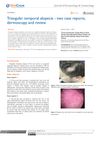
February 2018 in “Journal of dermatology & cosmetology” This article discusses triangular temporal alopecia, highlighting dermoscopy's role in diagnosis and the limited therapeutic options, without reporting new clinical results.
 January 2018 in “Springer eBooks”
 Congenital triangular alopecia is a harmless, non-spreading hair loss condition often seen in young children.
 4 citations
,
July 2019 in “Clinics in Dermatology”
4 citations
,
July 2019 in “Clinics in Dermatology” This article reviews various "white diseases" characterized by hypopigmentation or depigmentation and emphasizes the role of melanosomes in skin and eye color, but it does not present new clinical results.
September 2024 in “Dermatologica Sinica” This article describes a 10-month-old female with congenital smooth muscle hamartoma, highlighting the importance of differential diagnosis in congenital skin lesions due to potential malignancy risks.
January 2021 in “Digital Commons - PCOM (Philadelphia College of Osteopathic Medicine)” This review discusses recent findings related to sebaceous gland conditions, including updated recommendations for screening in sebaceous neoplasms and potential treatments for acne vulgaris, though no new definitive clinical results are reported.
 September 2023 in “International Journal of Community Medicine and Public Health”
 This source reviews a range of sebaceous gland disorders, exploring their clinical characteristics, risk factors, and common treatments, including conditions such as sebaceous gland hyperplasia and acne vulgaris, and highlighting various therapeutic approaches.
5 citations
,
October 2021 in “Journal of the American Academy of Dermatology” PRAME helps distinguish between benign and malignant skin cells in most cases.
September 2023 in “Journal of the American Academy of Dermatology” A rare benign scalp tumor in an infant requires surgical removal.

In this case report, researchers diagnosed a 12-year-old girl with a nevus sebaceus of Jadassohn, characterized by a yellowish-pink plaque on the scalp and a genetic variant, following previous misdiagnosis as alopecia areata.
 34 citations
,
December 1995 in “Pediatric Dermatology”
34 citations
,
December 1995 in “Pediatric Dermatology” In this study, researchers reported a 0.11% occurrence of congenital triangular alopecia, recommending surgical treatment for women but not for men due to later potential development of androgenic alopecia.
 January 2026 in “Dermatology and Therapy”
 This study suggests that using UVFD to examine non-pigmented facial lesions can potentially enhance diagnostic accuracy and reduce unnecessary biopsies.
 March 2026 in “Scientific Journal”
 This case study reported a 15-year-old girl with a nevus sebaceus of Jadassohn, where a secondary neoplasm potentially developed into either pigmented trichoblastoma or pigmented basal cell carcinoma, highlighting the importance of early recognition and evaluation of such lesions for effective management.
 1 citations
,
December 2019 in “American journal of ophthalmology. Case reports”
1 citations
,
December 2019 in “American journal of ophthalmology. Case reports” This case report describes an unusual occurrence of late-onset nevus comedonicus affecting both eyelids, with complications including bilateral ptosis and ectropion.
 5 citations
,
May 2021 in “BMC surgery”
5 citations
,
May 2021 in “BMC surgery” This report of a rare case describes cutis verticis gyrate secondary to cerebriform intradermal nevus, emphasizing individualized treatment plans based on patient preference and condition severity.
 4 citations
,
August 2017 in “International journal of molecular sciences”
4 citations
,
August 2017 in “International journal of molecular sciences” This study observed two cases of pigmented epithelioid melanocytoma suggesting potential differing origins: one from a hair follicle's outer root sheath and another from an intradermal nevus.
 1 citations
,
September 2011 in “UHOD : Uluslararası hematoloji - onkoloji dergisi”
1 citations
,
September 2011 in “UHOD : Uluslararası hematoloji - onkoloji dergisi” This study found no significant differences in age, sex, or histopathological characteristics for differentiating basal cell carcinoma from benign tumors of cutaneous appendages, complicating diagnosis.
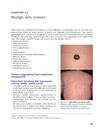
This chapter classifies various benign skin tumors and discusses their characteristics, treatment indications, and potential for recurrence, but reports no new clinical findings.
 April 2016 in “Journal of the American Academy of Dermatology”
 Dermoscopy helped correctly diagnose a skin condition that was previously misidentified as a different hair loss disease.
 23 citations
,
May 1984 in “Journal of the American Geriatrics Society”
23 citations
,
May 1984 in “Journal of the American Geriatrics Society” Benign Prostatic Hyperplasia may be caused by changes in how the body processes male hormones.
 8 citations
,
November 2015 in “Saudi Journal of Biological Sciences”
8 citations
,
November 2015 in “Saudi Journal of Biological Sciences” This study found that KH053, combining Panax ginseng and bee-pollen, significantly reduced prostate weight and DHT levels, inhibiting BPH development in a rat model.
 2 citations
,
January 2025 in “Frontiers in Pharmacology”
2 citations
,
January 2025 in “Frontiers in Pharmacology” In a rat model of benign prostatic hyperplasia, this study found that purple corn extract may improve symptoms by inhibiting prostate enlargement, reducing androgen receptor signaling, and exerting anti-inflammatory effects.