 16 citations
,
January 2015 in “Annals of Dermatology”
16 citations
,
January 2015 in “Annals of Dermatology” In this study, trichoscopic features aiding differential diagnosis of alopecia in Korean patients were found to be similar to those in Caucasians, but pigment pattern frequencies differed due to racial characteristics.
 1 citations
,
January 2024 in “Annals of Dermatology”
1 citations
,
January 2024 in “Annals of Dermatology” This study suggests that analyzing microscopic hair morphology, particularly loss of typical clubbing and proximal tapering, may help predict the clinical course of alopecia areata.
 3 citations
,
December 2013 in “Journal of Dermatology”
3 citations
,
December 2013 in “Journal of Dermatology” This study found that scanning electron microscopy can identify four specific hair morphology patterns in alopecia areata patients, offering a less invasive diagnostic option compared to punch biopsy.
 47 citations
,
July 2005 in “British Journal of Dermatology”
47 citations
,
July 2005 in “British Journal of Dermatology” This study found no protective effect of topical calcipotriol on hair loss in chemotherapy patients, and the authors propose the term "atrophic telogen effluvium" for this type of hair loss.
 2 citations
,
March 2018 in “The Journal of Dermatology”
2 citations
,
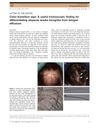
March 2018 in “The Journal of Dermatology” This letter discusses a trichoscopic feature called the color-transition sign for differentiating between alopecia areata incognita and telogen effluvium, and reports no new clinical results.