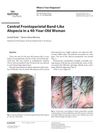
A woman's hair loss was correctly diagnosed as Lichen planopilaris after initial misdiagnosis, highlighting the usefulness of trichoscopy in diagnosing hair disorders.
1 citations
,
February 2014 in “Hair therapy & transplantation”
This case report describes a one-year-old boy with combined occipito-linear and triangular fronto-temporo-parietal alopecia and discusses the possibility of these lesions being a variant of neonatal occipital alopecia.
4 citations
,
January 2020 in “Skin appendage disorders”
This case report describes a unique presentation of frontal fibrosing alopecia characterized by a hair loss pattern that resembles the Greek letter upsilon, supported by trichoscopic and histological findings.
16 citations
,
January 2017 in “Anais brasileiros de dermatologia/Anais Brasileiros de Dermatologia”
This case study discusses a postmenopausal woman's frontal fibrosing alopecia and lichen planus pigmentosus, controlled with corticosteroids and finasteride, highlighting diagnostic and therapeutic challenges in scarring alopecia.
130 citations
,
May 1988 in “Journal of The American Academy of Dermatology”
This study found that frontal and frontoparietal hair recession is relatively common in women, especially after menopause, and may not indicate abnormal androgen metabolism absent other virilization signs.
Hair transplantation moves DHT-resistant follicles from a donor area (back and sides of the scalp) into thinning or bald areas. The transplanted hair is generally permanent, though surrounding native hair can keep thinning.
How does tofacitinib differ when used orally versus topically in hair loss treatment research?Oral tofacitinib acts on immune signalling throughout the body and has the stronger regrowth evidence in alopecia areata, alongside an FDA boxed warning; topical tofacitinib aims to act only on the scalp, but the human evidence is a handful of small compounded-formulation studies with no large randomized trial. Neither route is approved for hair loss, and regrowth generally reverses after treatment stops.
Got small bald patches they say are from stress? PP405 sprays could help bring them back to life.PP405 is an experimental topical gel from Pelage Pharmaceuticals that inhibits the mitochondrial pyruvate carrier; its registered Phase 2 trial (NCT06393452) tested it once daily in 78 adults with pattern hair loss, for safety and tolerability. It is not approved, not for sale, and has not been studied in alopecia areata or stress-related shedding.
Tried everything and still getting bald patches? Procapil may help calm the immune responseProcapil is a cosmetic ingredient complex; laboratory studies of its individual ingredients report anti-inflammatory effects, but no published clinical trial has tested it in alopecia areata or any other immune-related hair loss. Spreading bald patches should be assessed by a dermatologist.
Alfatradiol: Can it help if my hair loss is linked to DHT?The one randomised trial of topical alfatradiol — in 103 women — found hair thickness and density essentially unchanged after six months, while minoxidil improved both; its authors credited alfatradiol with slowing hair loss rather than regrowing hair. Laboratory work supports a local effect on follicular DHT, but no controlled trial in men appears to have been published.
A user is starting a topical finasteride treatment for diffuse patterned alopecia, having previously used minoxidil without success. They are cautious about side effects and have chosen topical over oral finasteride, while also using Nizoral and biotin in their routine.
A user has been experiencing hair loss for 4 years, with treatments like minoxidil, finasteride, and various supplements proving ineffective. They were diagnosed with fibrosing alopecia in a pattern distribution, a condition that may require a combination of anti-inflammatory and hair growth treatments.
User started Finasteride for hair loss and uses Toppik to cover bald spots. They wonder if Toppik's keratin fibers will block follicles and affect hair regrowth.
The user is experiencing severe hair loss and color change despite low testosterone levels and healthy lifestyle changes. They have tried ketoconazole shampoo and consulted a dermatologist, who found no scalp issues but suggested using Toppik for coverage.
A 25-year-old male experienced significant hair loss due to telogen effluvium and androgenetic alopecia. He began using finasteride, minoxidil, and vitamins, seeing some regrowth but remains worried about hair density.