 25 citations
,
August 2017 in “Lasers in Medical Science”
25 citations
,
August 2017 in “Lasers in Medical Science” This literature review reported that fractional lasers, like the 1550-nm nonablative erbium-glass laser, may enhance hair regrowth by stimulating a wound healing process, but more randomized controlled trials are needed to confirm their effectiveness and optimize treatment parameters.
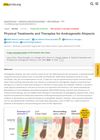
This review discusses various physical therapies for androgenetic alopecia, reporting that low-level laser therapy has the most evidence but highlighting other promising treatments, such as non-ablative lasers and multimodal approaches, that warrant further investigation.
 48 citations
,
January 2014 in “Dermatology Online Journal”
48 citations
,
January 2014 in “Dermatology Online Journal” This review examines various treatments for dissecting cellulitis, noting isotretinoin may offer the best chance for remission despite limited long-term data and calls for more clinical studies.
3 citations
,
August 2021 in “Journal of Cosmetic Dermatology” This study found that non-ablative Er:YAG laser treatment, alone or combined with other therapies, effectively improved hair quality and reduced AGA grade in patients, with high satisfaction reported and no adverse reactions.
November 2024 in “Dermatology and Therapy” In this review, cosmetic practices such as non-ablative lasers, autologous fat injections, and oral isotretinoin may help alleviate certain symptoms of frontal fibrosing alopecia, while treatments like deep chemical peels and ablative laser therapies are contraindicated due to potential scarring risks.