21 citations
,
September 2022 in “Actas Dermo-Sifiliográficas” This study reviews the use of trichoscopy in diagnosing and monitoring alopecia areata, highlighting that certain trichoscopic findings like yellow and black dots, exclamation mark hairs, and others, provide valuable insights into disease status and treatment response.
4 citations
,
February 2022 in “Journal of Cosmetic Dermatology” This study found that dermatoscopic features can distinguish between tinea capitis and alopecia areata in children, with tinea capitis commonly showing comma hairs and alopecia areata showing exclamation mark hairs.
 July 2021 in “Indian journal of dermatopathology and diagnostic dermatology”
 In this study, researchers documented several trichoscopic features that were statistically significant indicators of alopecia and scalp disorders compared to healthy controls.
 June 2018 in “The Medical Journal of Cairo University/The Medical Journal of Cairo University”
 This study found that dermoscopy is effective for distinguishing Tinea Capitis from Alopecia Areata by identifying unique trichoscopic features specific to each condition.
 43 citations
,
August 2013 in “Pediatric Dermatology”
43 citations
,
August 2013 in “Pediatric Dermatology” This review discusses the use of trichoscopy in diagnosing and managing pediatric hair and scalp disorders and reports no new experimental findings.

This article presents a dermatological case involving a 36-year-old woman with ambiguous alopecia, evaluated using videodermatoscopy, but it reports no new research findings or clinical outcomes.
 245 citations
,
March 2012 in “Journal of The American Academy of Dermatology”
245 citations
,
March 2012 in “Journal of The American Academy of Dermatology” This review discusses the dermoscopic features of common hair and scalp disorders and reports no new clinical results, aiming to assist dermatologists in diagnosing conditions like tinea capitis and alopecia areata.
 143 citations
,
October 2008 in “Journal of The American Academy of Dermatology”
143 citations
,
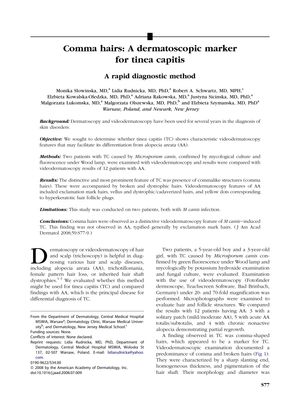
October 2008 in “Journal of The American Academy of Dermatology” This study found that comma hairs are a distinctive feature of tinea capitis caused by Microsporum canis, distinguishing it from alopecia areata, which is characterized by exclamation mark hairs.