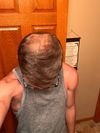
The user noticed spots on their thinning scalp area and is using oral Minoxidil and a topical serum. They are seeking advice on the cause of the spots.
The post and conversation discuss the link between DHT (a hormone), scalp itchiness, and hair loss. Some users share their experiences and treatments, including the use of fluconazole, corticosteroids, and ketoconazole shampoo, with one user suspecting minoxidil as a potential cause of their symptoms.
The conversation discusses the potential updates on the pp405 trial for hair loss, with completion expected by December 2025. Participants express skepticism about new treatments, suggesting continued use of finasteride, while others hope for innovative solutions beyond current medications.
The user is considering switching from topical to oral finasteride due to lack of progress with their current hair loss treatment, which includes topical fin/min, microneedling, Nizoral shampoo, oral minoxidil, biotin, collagen, tretinoin, and hair masks. A suggestion was made to try oral finasteride for potentially better results and to monitor progress over 6-12 months.
The conversation is about obtaining affordable hair loss treatments, specifically dutasteride and minoxidil, through Costco and other pharmacies without needing a membership. The user shares their experience of getting prescriptions from Dr. B’s and Ro, highlighting the cost-effectiveness of their regimen.
KX-826 Phase II results show that a 0.5% concentration performs better than 1% for treating male pattern baldness. Concerns about receptor upregulation from long-term DHT antagonism were mentioned.
KX-826 combined with minoxidil significantly increases hair growth compared to minoxidil alone for treating male androgenetic alopecia, with no unexpected safety concerns. Users discuss various hair loss treatments, including KX-826, minoxidil, finasteride, and RU58841, sharing personal experiences and sourcing information.
Topical finasteride is considered safer for the liver than oral finasteride due to less systemic absorption, but regular liver function tests are advised. The user is concerned about liver health due to a history of NAFLD and is exploring topical finasteride as a safer alternative.
Low-level laser therapy (LLLT) is debated for hair regrowth, with some users suggesting it should be combined with treatments like minoxidil and finasteride for effectiveness. Many users express skepticism about LLLT's efficacy and cost, emphasizing the need for the correct wavelength and quality devices.
Elevated bile acids can inhibit the enzyme AKR1C2, leading to increased DHT levels, which may accelerate hair loss in those predisposed to androgenetic alopecia. Treatments mentioned include topical minoxidil and finasteride.
A user discusses the legitimacy of Kintor's KX-826 for hair loss, available on Amazon through Koshine Biomedica. They decided to order it after finding a document linking Kintor and Koshine as collaborators.
The conversation is about a hair loss serum mix containing 5% capixyl, 3% redensyl, and procapil. The user is asking for recommendations or opinions on the effectiveness of this product.
The user is concerned about hair loss despite using oral finasteride, oral minoxidil, and topical minoxidil. They are seeking advice on additional blood tests to identify potential causes.
A potential new hair loss treatment, HMI-115, and the possibility of discontinuing finasteride in favor of it. The conversation also includes discussion about other benefits of using finasteride.
HairClone aims to rejuvenate miniaturizing hair follicles through follicle banking and cell expansion, with treatments potentially available in the UK by 2022. The process involves extracting, storing, and cloning hair follicles, but full regenerative treatments will take many years to develop.
RU58841 can be absorbed systemically after topical application, but the study did not find immediate hormonal disruption. The study highlights the need for more research on long-term safety and effects of RU58841, as well as the importance of quality control in products from the grey market.
Oral dutasteride 0.5 mg combined with oral minoxidil 2.5 mg is highly effective for male androgenetic alopecia, showing over 60% improvement and 98% stabilization at 6 months, with low adverse event rates. Patients with severe baseline conditions respond better and faster to this treatment.
A user shared their experience with hair loss treatments, initially using oral dutasteride (Avodart) and minoxidil, and recently switching to a topical dutasteride solution. They reported significant hair improvement over time and are hopeful about the new topical treatment.
The conversation discusses using finasteride for hair loss and its side effect of erectile dysfunction (ED), with some users suggesting reducing the dose to 0.5mg to minimize side effects. Cialis is recommended for managing ED, and other suggestions include monitoring hormone levels and considering supplements like DIM or L-Citrulline.
The conversation discusses hair loss treatments, specifically finasteride, minoxidil, and onion-based products. Users joke about the smell and effectiveness, with some suggesting onion products might be a placebo or scam.
Many men learn about finasteride too late for effective hair loss treatment. Early use of finasteride is crucial, but fear of side effects and lack of awareness hinder timely adoption.
A 17-year-old is concerned that taking finasteride might affect facial bone growth and is considering switching to topical finasteride due to its reduced systemic effects. They are also using oral minoxidil and exploring other hair loss treatments like microneedling and ketoconazole shampoo.
Switching from finasteride to dutasteride and oral minoxidil led to thicker hair and reduced hairline recession. Occasional flushing from minoxidil will be managed by lowering the dose.
Pyrilutamide shows minimal systemic absorption with low plasma levels and no accumulation, suggesting it's unlikely to cause systemic side effects. However, full results are not yet published in scientific journals.
The user has been using oral Minoxidil, finasteride, dermastamping, and Ketoconazole for hair regrowth with positive results and no side effects. They plan to switch to dutasteride but face challenges obtaining it legally in Germany.
A new light therapy claims to reduce hair loss markers by 92% using a specific wavelength range. Users discuss the cost and effectiveness of devices, with some expressing skepticism and others considering alternative treatments like red light therapy and vitamin D exposure.
Finasteride is more effective for long-term hair maintenance by addressing the root cause of hair loss, while minoxidil acts as a growth stimulant with faster visible results. Combining both treatments is optimal, with oral minoxidil often showing better results for some individuals.
Clascoterone is a topical treatment for androgenetic alopecia, showing modest to moderate hair regrowth, and may be available by 2027-2028. It is considered safer than finasteride, with discussions on its effectiveness compared to RU58841 and pyrilutamide.
A 19-year-old is experiencing crown thinning after three months on finasteride and minoxidil, hoping it's just a shedding phase. They also use a dermaroller weekly and seek hair regrowth and stabilization.