Pyrene Excimer Nucleic Acid Probes for Biomolecule Signaling
October 2009
in “
Journal of Biomedical Nanotechnology
”
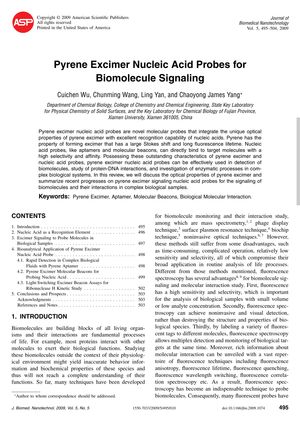
Studysummary This review discusses pyrene excimer nucleic acid probes for detecting biomolecules and protein-DNA interactions and reports no new experimental findings. Our plain-language summary of this paper — not a Tressless recommendation.
The document reviewed the use of pyrene excimer nucleic acid probes for biomolecule signaling, emphasizing their advantages in detecting biomolecules with high selectivity and minimal background interference due to their large Stokes shift and long fluorescence lifetime. It highlighted a study by Wu et al. from 2009, where a light-switching excimer aptamer was developed for the sensitive detection of PDGF-BB, demonstrating the ability to provide qualitative and quantitative analyses with a detection limit in the picomolar range. The document also acknowledged the challenges of these probes, such as poor water solubility and low fluorescence quantum yield, but suggested that these could be overcome with modifications. Overall, the document concluded that pyrene excimer nucleic acid probes show promise for biological research and drug screening applications.