Pill Organizers and Cutters: Risks and Restrictions on Use
February 2013
in “
Revista De Saude Publica
”
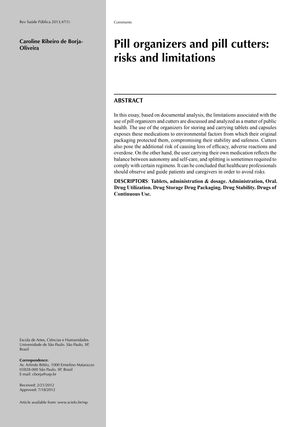
Studysummary This article examines the public health risks and benefits of pill organizers and cutters, concluding that healthcare professionals should guide their use to prevent potential medication stability and efficacy issues. Our plain-language summary of this paper — not a Tressless recommendation.
The document from 2013 discusses the risks and limitations of using pill organizers and cutters, indicating that while they can improve medication adherence, they may also compromise medication stability and safety by exposing them to environmental factors and altering expiration dates and efficacy. It highlights the potential for uneven dosing from pill cutters, particularly for medications with a narrow therapeutic range, which could lead to adverse reactions or reduced efficacy. The document cites a study from Nigeria with approximately 300 HIV positive patients that found pill organizers improved adherence to anti-retroviral treatment. It also references a study by Auricchio et al. that showed dividing atenolol tablets did not significantly alter active ingredient levels, but the resulting fragments had active ingredient levels above the recommended variation limit, posing a risk to treatment efficacy. The document warns against modifying the release of medications with special coatings or formulations and stresses the importance of healthcare professionals providing proper guidance on the use of these tools to minimize risks.