Production and Characterization of Human Hair Keratin Bioplastic Films With Novel Plasticizers
January 2024
in “
Scientific reports (Nature Publishing Group)
”
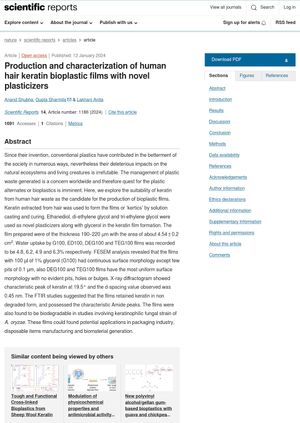
Studysummary This study explored using keratin extracted from human hair waste to create biodegradable bioplastic films, revealing promising potential for applications in packaging and disposable items due to their uniform surface morphology and ability to degrade with keratinophilic fungi.
Our plain-language summary. Not medical advice or a treatment recommendation. Consult a qualified healthcare professional before changing treatment. Full disclaimer
The study used keratin from human hair waste to create bioplastic films, or 'kertics', with the help of novel plasticizers such as ethanediol, di-ethylene glycol, tri-ethylene glycol, and glycerol. The films were 190-220 µm thick, had an area of about 4.54 ± 0.2 cm2, and their water uptake varied between 4.8% and 6.3%. X-ray and FTIR studies confirmed the presence of non-degraded keratin. The films were found to be biodegradable in studies involving a keratinophilic fungal strain of A. oryzae. The study suggests these films could be used in the packaging industry, disposable items manufacturing, and biomaterial generation.