4D Polycarbonates via Stereolithography as Scaffolds for Soft Tissue Repair
July 2021
in “
Nature Communications
”
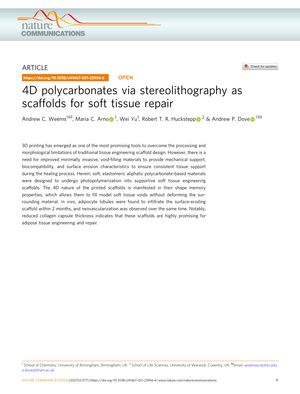
Studysummary This study reported that 4D-printed, aliphatic polycarbonate-based scaffolds supported adipose tissue engineering by allowing adipocyte infiltration and neovascularization in vivo, indicating potential for effective adipose tissue repair. Our plain-language summary of this paper — not a Tressless recommendation.
The study investigated the development of 4D polycarbonate scaffolds using stereolithography for soft tissue repair, highlighting their shape memory properties and biocompatibility. In vivo experiments with murine models showed successful adipocyte infiltration and neovascularization within 2 months, with minimal immune response and necrosis. The scaffolds demonstrated reduced collagen capsule thickness and maintained approximately 80% mass after 4 months, suggesting a potential total mass loss within 20 months. The materials were designed to degrade into nonacidic products, ensuring cytocompatibility, and supported cell proliferation in 3D cultures. The study concluded that these scaffolds have significant potential for tissue engineering due to their printability, mechanical strength, and ability to conform to various void shapes, enhancing healing and patient recovery with minimal surgical impact.