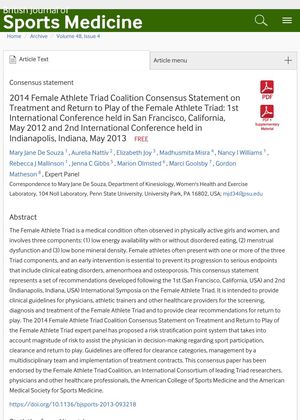
2014 Female Athlete Triad Coalition Consensus Statement on Treatment and Return to Play of the Female Athlete Triad: 1st International Conference Held in San Francisco, California, May 2012 and 2nd International Conference Held in Indianapolis, Indiana, May 2013

    January 2014 in “ British Journal of Sports Medicine
    Mary Jane De Souza, Aurelia Nattiv, Elizabeth A. Joy, Madhusmita Misra, Nancy I. Williams, Rebecca J. Mallinson, Jenna C. Gibbs, Marion P. Olmsted, Marci Goolsby, Gordon O. Matheson, Expert Panel
    From the encyclopedia
    Vitamin D →

    vitamin you should probably be taking for general health might also help your hair a little

    Image
    Studysummary This consensus statement discusses guidelines for screening, diagnosing, and treating the Female Athlete Triad, and introduces a risk stratification system to assist healthcare providers with sports participation decisions.
    Our plain-language summary. Not medical advice or a treatment recommendation. Consult a qualified healthcare professional before changing treatment. Full disclaimer

    In 2014, the Female Athlete Triad Coalition released a consensus statement on the treatment and return to play of the Female Athlete Triad, a condition seen in physically active women, characterized by low energy availability, menstrual dysfunction, and low bone mineral density. The statement provided clinical guidelines for healthcare providers and recommended a risk stratification point system for decision-making regarding sport participation. The panel emphasized the importance of a multidisciplinary healthcare team in diagnosing and treating the Triad. Non-pharmacological treatment strategies were suggested, primarily addressing low energy availability through diet and exercise modifications. If non-pharmacological treatments were unsuccessful after a year, pharmacological management was suggested. The panel also recommended lifestyle and behavioral changes, and optimal intake of calcium and vitamin D. The guidelines proposed a risk stratification system to determine clearance for participation in sports, with the team physician having the ultimate authority in the decision-making process.
    Discuss this study in the Community →

    Research cited in this study

    1 / 1 results