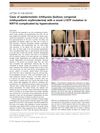
 October 2011 in “Journal of dermatology”
 A man with a rare skin condition and a new gene mutation developed high calcium levels due to his treatment.
 14 citations
,
September 2018 in “The journal of allergy and clinical immunology/Journal of allergy and clinical immunology/The journal of allergy and clinical immunology”
14 citations
,
September 2018 in “The journal of allergy and clinical immunology/Journal of allergy and clinical immunology/The journal of allergy and clinical immunology” In this study, a novel homozygous mutation in the STAT5B gene was identified in a 17-year-old boy with growth hormone-refractory growth failure, severe eczema, and autoimmune disease, suggesting a similarity to known STAT5B deficiency phenotypes.
 17 citations
,
October 2006 in “Molecular and Cellular Endocrinology”
17 citations
,
October 2006 in “Molecular and Cellular Endocrinology” This study found that the L457(3.43)R mutation in the human luteinizing hormone receptor increases phosphodiesterase activity, reducing hormonal response despite elevated basal cAMP levels.
 August 2016 in “Journal of Investigative Dermatology”
 This case report identifies a novel LIPH gene mutation linked to autosomal recessive woolly hair/hypotrichosis in a Japanese boy, expanding the spectrum of known mutations associated with this condition.
7 citations
,
February 2011 in “Journal of dermatology” This study identified a specific LIPH gene mutation (736T>A) as common in Japanese patients with autosomal recessive woolly hair/hypotrichosis, potentially indicating its role in the condition's manifestation within this population.
 9 citations
,
February 2018 in “The Journal of Dermatology”
9 citations
,
February 2018 in “The Journal of Dermatology” This study identified a novel splice site mutation in the LIPH gene associated with autosomal recessive woolly hair, contributing to understanding the genetic basis of this condition.
2 citations
,
January 2024 in “Revista Paulista de Pediatria” In this case report, researchers described a 6-year-old girl with severe mandibuloacral dysplasia type A, noting unique physical deformities and a rare homozygous LMNA gene mutation not commonly associated with the condition.
1 citations
,
September 2020 in “Journal of dermatology” This study identified a novel mutation and confirmed a previous mutation in the LIPH gene in a woman with autosomal recessive woolly hair, expanding the mutation spectrum for this condition.
 13 citations
,
November 2012 in “PLoS ONE”
13 citations
,
November 2012 in “PLoS ONE” This study identified a novel recessive mutation in mice causing lethal congenital lamellar ichthyosis, with skin and hair follicle alterations similar to human congenital ichthyoses, linked to a specific genetic defect affecting Fatp4.
5 citations
,
June 2008 in “British Journal of Dermatology”  September 2016 in “Journal of Dermatological Science”
 This study identified that in Japanese patients with autosomal recessive woolly hair/hypotrichosis, the c.736T > A LIPH mutation is associated with a mild phenotype, while the c.742C > A mutation may lead to severe baldness.
22 citations
,
February 2012 in “Journal of Investigative Dermatology” A specific gene mutation causes severe skin and nail issues and hair loss.
2 citations
,
June 2013 in “Journal of Clinical Pathology” This article reviews the role of LMNA gene mutations, particularly in Hutchinson–Gilford progeria syndrome, but does not report new experimental findings.
 20 citations
,
May 2013 in “International Journal of Molecular Medicine”
20 citations
,
May 2013 in “International Journal of Molecular Medicine” This study identified a novel missense MAFB variant in a family with some unaffected members, suggesting incomplete penetrance and the potential influence of modifier genes, epigenetic mechanisms, or environmental factors on MCTO phenotype.
 6 citations
,
May 2012 in “Archives of Dermatological Research”
6 citations
,
May 2012 in “Archives of Dermatological Research” This study reports a novel missense mutation in the HR gene in a 68-year-old Hungarian woman with alopecia universalis and limb deformities, suggesting a need for further research on its role in these conditions.
12 citations
,
March 2012 in “JEADV. Journal of the European Academy of Dermatology and Venereology/Journal of the European Academy of Dermatology and Venereology” This study observed that some patients with homozygous c.736T>A mutation in LIPH may have mild hypotrichosis with long hairs in adulthood.
11 citations
,
December 2017 in “Orphanet Journal of Rare Diseases” This study found a previously unreported ST14 gene mutation in a patient with ichthyosis-hypotrichosis syndrome, highlighting novel skin and hair characteristics and emphasizing the critical role of the Asp482 amino acid in matriptase activation.
11 citations
,
April 2012 in “Journal of Investigative Dermatology” A specific mutation in PA-PLA1α causes abnormal hair growth.
175 citations
,
September 1998 in “British Journal of Dermatology” This study found that mutations in the K17 gene underlie both pachyonychia congenita type 2 and steatocystoma multiplex phenotypes, regardless of the specific mutation involved.
3 citations
,
January 2013 in “Dermatology” This study identified novel compound heterozygous mutations in the hairless gene among a non-consanguineous Chinese family with congenital atrichia, illustrating phenotypic variations due to founder or modifier genes.
 September 2024 in “Journal of Medicine and Life”
 In this study, researchers identified a recurrent nonsense mutation, c.409C>T (p.Arg137*), in the COL7A1 gene through whole exome sequencing in a family with autosomal recessive dystrophic epidermolysis bullosa, demonstrating the importance of this method for diagnosing genetically complex conditions.
18 citations
,
January 2018 in “BMC dermatology” This paper describes a case of epidermolysis bullosa simplex with muscular dystrophy associated with a novel PLEC mutation and diffuse alopecia, highlighting a potential genetic link that remains uncertain.
 23 citations
,
December 2013 in “British Journal of Dermatology”
23 citations
,
December 2013 in “British Journal of Dermatology” This study identified a new PNPLA1 mutation in a Spanish family with autosomal recessive congenital ichthyosis.
June 2026 in “British Journal of Dermatology” In this case report, researchers observed a Slovakian neonate with a rare EGFR genetic mutation who presented with severe neonatal dermatoses, ichthyosis, and multisystem complications, emphasizing the significance of genetic diagnosis for such complex conditions.
 April 2026 in “Human Genome Variation”
 In this study, researchers identified a recurrent MBTPS2 splice-site variant as a mutational hotspot in IFAP syndrome across diverse families, with phenotype severity suggesting the influence of additional modifiers.
November 2012 in “Experimental and Clinical Endocrinology & Diabetes” This case report describes a 46,XY female patient with a novel homozygous nonsense mutation in the LHCGR gene, highlighting the need for molecular analysis in disorders of sexual development.
7 citations
,
August 2017 in “European journal of endocrinology” This study suggests that mutations in exon 10 of the POC1A gene may be linked to a distinct clinical condition characterized by extreme insulin resistance and short stature, differing from SOFT syndrome.
May 2023 in “Pharmaceuticals” In this in silico study, researchers analyzed nonsynonymous SNPs in the LIPH gene linked to hypotrichosis and identified three potentially harmful variants (W108R, C246S, and H248N) out of 215 total, using sequence- and architecture-based bioinformatics techniques to differentiate between harmful and benign SNPs.
 14 citations
,
July 2010 in “Experimental Dermatology”
14 citations
,
July 2010 in “Experimental Dermatology” A new mutation in the HR gene causes hair loss in a specific family.
7 citations
,
August 2017 in “Genetic testing and molecular biomarkers” This report suggests that patients with primary spontaneous pneumothorax should be evaluated for FLCN mutations, as they may indicate Birt-Hogg-Dube syndrome and associated cancer risks.