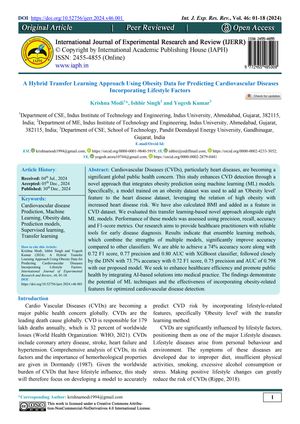
A Hybrid Transfer Learning Approach Using Obesity Data for Predicting Cardiovascular Diseases Incorporating Lifestyle Factors
December 2024
in “
International Journal of experimental research and review
”
Studysummary In this study, the integration of obesity-related features and machine learning techniques significantly enhanced cardiovascular disease detection, with the XGBoost classifier achieving a 74% accuracy rate and improved metrics compared to other models.
Our plain-language summary. Not medical advice or a treatment recommendation. Consult a qualified healthcare professional before changing treatment. Full disclaimer
This study presents a novel approach to enhance cardiovascular disease (CVD) detection by integrating obesity prediction into machine learning (ML) models. By adding an 'Obesity level' feature and calculating BMI in the CVD dataset, the research leverages the link between obesity and heart disease risk. The study evaluated eight ML models, finding that ensemble learning methods, particularly the XGBoost classifier, significantly improved accuracy, achieving a 74% accuracy score, 0.72 F1 score, 0.77 precision, and 0.80 AUC. The deep neural network (DNN) also performed well with 73.7% accuracy. These findings highlight the potential of ML techniques and obesity-related features in optimizing CVD detection, aiming to enhance healthcare efficiency and promote public health.